Bonus — Florida drought and wildfires rage
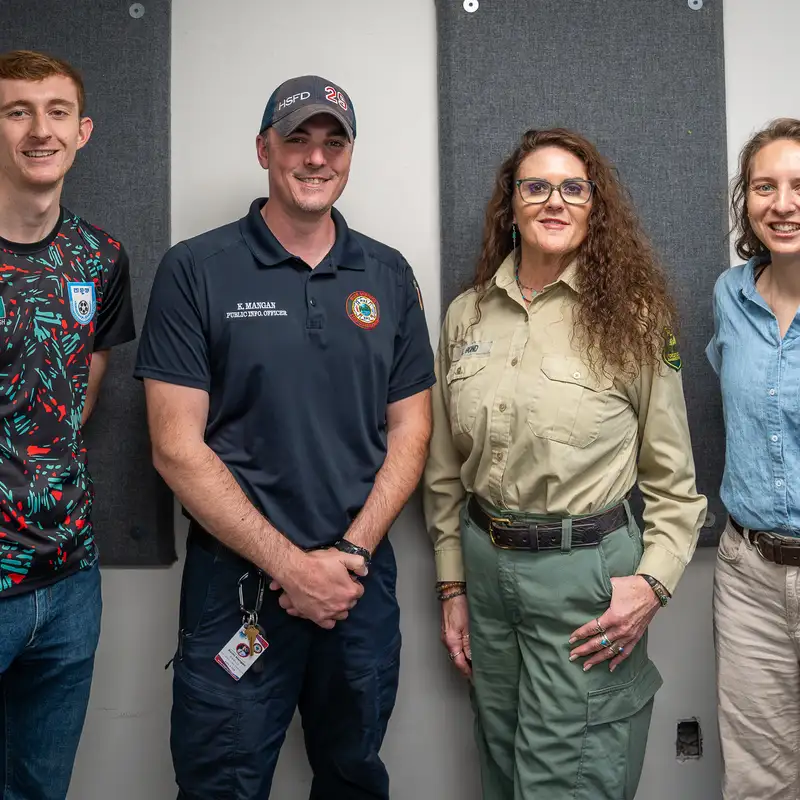
Hello from Gainesville, Florida. It's Thursday, March 18, and you're listening to StreetSmart. I'm associate editor Seth Johnson. Thanks to Forest Meadows Funeral Home, we're able to come to you on Thursdays as well as Mondays bringing some bonus content about the drought currently in Florida. With me this week is reporter Lillian Hamman, we've got some special guests on our show.
Lillian Hamman:We do. We have two guests that are gonna talk to us about the drought we're all going through and the wildfires that can come from it.
Seth Johnson:We've got Kevin Mangan with the High Springs Fire Department along with Ludie Bond with the Florida Forest Service. Welcome.
Ludie Bond:Thanks for having us.
Kevin Mangan:Doctor. Bond.
Ludie Bond:Dr. Bond, that's correct.
Seth Johnson:And Kevin, we'll start with you and then we'll move on to Dr. Bond. But can you guys both give us brief intros into how you guys have been involved in fire service here in Florida?
Kevin Mangan:Sure. So I am the public information officer for the High Springs Fire Department. I've been with the agency since 2012, and I've been the department's full time PIO since 2020.
Ludie Bond:And I'm a public information officer with the Florida Forest Service. I've been with them since 2000, so about twenty five years doing this. And I do work with, local citizens as well as media, with regards and will state, regional, national, sometimes international media with respect to prescribed fire information, wildfire causes, wildfire prevention, all things fire.
Kevin Mangan:So if you've seen Anchorman, Ron Burgundy thinks he's kind of a big deal. Dr. Bond's kind of a big deal.
Ludie Bond:Oh, thank you.
Kevin Mangan:She's a pro. She is a pro. Seriously, if I, if I ever need a gut check or I need to figure out how to actually do my job, then I'm just gonna call Ludi and she'll tell me.
Ludie Bond:Thank you for that. I appreciate you saying that.
Lillian Hamman:So how bad is the drought that we're in right now?
Ludie Bond:Well, it's it's pretty bad. The majority of Florida is in a drought somewhat of a drought condition, right now from pretty much Key West even up up to Pensacola. So different areas are in severe, some are in moderate, some are in extreme. We haven't hit the extraordinary drought level yet, but there's not really much rain predicted for the next couple of months. So it's supposed to, unfortunately, get worse before it gets better.
Seth Johnson:And the Forest Service is already seeing it be kind of a lot higher than usual with fires during these dry conditions, right?
Ludie Bond:Yeah, that's exactly right, Seth. We are coming into the winter months extremely dry, as most people know. We didn't have hurricanes. We didn't have tropical systems move through, which brings us the necessary rain that we need in our water tables and the rain that we need to be able to conduct prescribed burning during the dormant season, which is usually what we should be doing right now. But instead, we're chasing fires because we really haven't had any significant rain, since since the fall, and many areas are in, like, 15 to 16 inch rain deficit, and it's predicted to get even worse.
Ludie Bond:And so actually, we're breaking some records with wildfire wildfire occurrence from January 1 until now. We've the Florida Forest Service has responded to about a thousand wildfires statewide for approximately 35,000 acres. So that's much higher numbers than we've than I can remember seeing, and I've been doing this for twenty five years. With the hurricane season, it's interesting how one natural disaster impacts another. So usually when we have hurricanes in Florida, they bring all that rain that we need, but also strong winds that blow timber down.
Ludie Bond:You have saltwater intrusion storm surge. All of that is reflected then in the upcoming wildfire seasons. But this year, it was the lack of a natural disaster that has now led us to what we're facing right now in Florida, which is truly a natural disaster. Just earlier this month, the the governor just declared a state of emergency statewide for Florida because not only of the drought, but the hard freezes that we've had come through the state as well, which has not only contributed to wildfire occurrence, but it's really hurt our farmers. So you think, you know, they depend on this rainwater, these these hard freezes.
Ludie Bond:And we've had some, deaths with man manatee mortality happen as well with these hard freezes. So we've been really been hit hard with weather occurrences moving through the state, and it's not gonna get better for a while.
Lillian Hamman:Yeah. It just was recently out at the La Chua Trail, and all the gators are out there, but the water is so low. And just wondering what's gonna happen to all of them and all the other ecosystems and things in the area that depend on all that. I know you said it'll have to get worse before it gets better, but how long does recovery take? How much rain would it take?
Lillian Hamman:How many hurricanes?
Ludie Bond:I know. Well and the hurricane season's way off. You know, summer summer's gonna be a while till it gets here. So just as these fronts are moving through, you know, we we're seeing some come through. They bring a little bit of rain anywhere from a quarter to a half an inch to an inch.
Ludie Bond:But, know, I mentioned we're in a rain deficit 15 to 16 inches. So while the rain is certainly welcome, it's not a season wildfire season ending rain just yet. Maybe that will come in May and June when we start seeing our typical afternoon thunderstorms. What these systems also bring with them, though, is strong gusting winds and lightning, and that certainly is going to lead to wildfire occurrence as well.
Seth Johnson:So, it sounds like people need to be prepared for the long haul with this. And that also involves home safety as increased brushfires, you know, talking about people's properties that could be on the line. Kevin, you guys deal with this up at High Springs. What are you recommending to people?
Kevin Mangan:Yeah, absolutely. It all comes down to kind of setting up a defensible space around your home and the various fronts that have come through in the very dry, windy days. It's no mystery that when you're walking around, your grass is really, really crunchy. All these leaves are coming I know I blow off my driveway and then three hours later it's filled with leaves again. So those are the things that can be very easily subject to fire.
Kevin Mangan:Whether it's the case of a lightning strike, if it's a fire on the side of the road from a dragging chain or something like that. So what you can do around your home is kind of clear away all that dead vegetation, rake up those leaves and get them out of the way and it's what we call it creating a defensible space around your home. And then you can further go from there by planting fire resistant plants around your home. There's a myriad of different things that you can do. UF/IFAS is probably a good resource for that.
Kevin Mangan:And does the Forest Service have something that can suggest that too?
Ludie Bond:Yeah, would say UF/IFIS is going to be your best source to look up vegetation that is less flammable than others. So, you're looking for more of a high moisture content. The interesting thing with our native vegetation in Florida is its primary purpose has been to carry fire from point a to point b. So you think of Palmetto, it's it's highly flammable because the wax is in resins. Sawgrass, you know, it burns across the water and it's high has a lot of oil content.
Ludie Bond:So we do have a lot of native vegetation that that is highly flammable. But your local county extension agent and the Florida Forest Service can help guide you through some of that.
Kevin Mangan:One of the big things too is going up on your roof and clearing those leaves away from your roof and out of your gutters. If you can get a cover for your gutters to prevent those leaves from going in there, it really just takes one ember falling from perhaps a nearby wildfire, whether it be a prescribed burn or an actual wildfire that ember can drop on down. Next thing you know, we've got a structure fire that we're dealing with.
Ludie Bond:Kevin brings up a really interesting point. People may think, Wait, I don't understand fire on my roof and my gutters. I thought fire traveled by ground. Well, those ember showers, as Kevin mentioned, can travel by air. I've seen homes burnt down to the ground, down to the platform, and there's green grass and chicken coops all around playground equipment all around the yard that survived, but the home didn't.
Ludie Bond:So that's something to keep in mind, how fire travels.
Kevin Mangan:To Ludie's point, seeing kind of the burn pattern of a lot of these brushfires we've gone on recently, if there's little strips of more green grass that is exactly that, the green grass is there, or maybe it's not even really grass, it's more weeds, but where the grass has actually died off and hasn't been able to survive, you can see the burn pattern go around that green area because that fuel isn't there. There's too much moisture content, it's not dry enough, and the fire is just gonna find that path of least resistance, it's gonna go where that dry fuel is, and it's fascinating to see what can happen. So, again, making that defensible space around your home is so, so, so important.
Seth Johnson:And you talked about chains dragging along the road, you know, potentially causing a spark. What are some of the other common causes of wildfires?
Ludie Bond:We've been well, these lightning strikes show, I mentioned that some of these systems, as they come through, bring a little bit of lightning. Well, we haven't had much just yet. That's normally more of a summertime thing where the temperatures start going up. So all the fires that we've been responding to are human caused. The majority are accidental.
Ludie Bond:They're not intentional. But it's something as as simple as mowing your lawn and the the lawnmower blade strikes a rock or you're edging around your carport and that blade can throw a spark. We've had welding equipment. We've had somebody was yesterday, we had a fire. Somebody was working on their car in their yard and it threw a spark.
Ludie Bond:We even had a pig roast that So cooking outdoors, you know, you have to be really careful with all of your outdoor activities because we are so extremely dry. A lot of people really don't have that situational awareness to know how much damage and how much danger a spark could cause.
Kevin Mangan:Parking on tall grass is a huge contributor. Your exhaust generates a lot of heat. That catalytic converter generates a lot of heat. So, especially where there's that tall grass that hasn't been mowed down and a car is just sitting there, it will not take long to spark off a fire. And next thing you know, it's running for acres and acres.
Kevin Mangan:People carelessly throwing out cigarette butts out the window, that's another cause too. But talking about the chains on your trucks and trailers, when you see those little spot fires along the road and there's a little one by one fire here and there's another one by one fire ten, fifteen, 20 feet down the road that is generally from a chain that's dragging and it's hitting that pavement, sparking off and throwing those sparks onto the dry grass.
Ludie Bond:So we have had some fires that threatened communities, threatened people's homes. And so people may be wondering, what if that happens to me? What do I do? How do I evacuate? How am I ready to be evacuated?
Ludie Bond:So there is a website people can go to called bewildfirereadyfl.com. That's bewildfirereadyfl.com. It gives you great ideas and tips on how to prepare your home, how to prepare your property, how to prepare a go kit should you have to evacuate. So all that information is there at your fingertips.
Kevin Mangan:I wanted to touch on a resource that we have, and I'll speak for Alachua County Emergency Management as well. But first, for our residents in High Springs, keeping in the know of potential evacuation orders, knowing about extension of burn bans or really any disaster or a thing that could impact the community, we encourage people to sign up for our text alerts at hsalerts.com. That's hsasinhighspringsalerts.com. You can choose what kind of alerts you get, when you get them, how you get them, text, email. Same thing for the county residents as well.
Kevin Mangan:Alachua County Emergency Management has their own. It's alertalachua.com. It's a very similar platform. Again, you can choose which alerts you choose to get. But for our High Springs residents, hsalerts.com, that'll notify them about other things in town too, should there be a boil water notice or a waterline break or a road closure due to ongoing construction or a traffic crash or something like that.
Ludie Bond:You know, Kevin mentioned Alachua Alert for Alachua County residents. Every county in Florida has an alert system you can sign up for. So regardless of what county you live in or are visiting, you certainly can sign up for those alerts. Couple of other links that people might find helpful. The Florida Forest Service has on our website the current wildfire information.
Ludie Bond:And on that page, you can click on a link to see where the current wildfires are near you that the Florida Forest Service is responding to. It's not all encompassing for every wildfire in Florida, but that can certainly give you an idea. We also have a link on that page that lists the current burn bans. Currently, there are 35 burn bans in our 67 counties. So over half the state has burn bans right now.
Ludie Bond:So that's something to keep in mind if you're traveling to another part of the state as well. But we have that link for you on our website.
Kevin Mangan:And what that burn ban means here in Alachua County is all outdoor burning is prohibited unless it is permitted by the Florida Forest Service or it is used for cooking in like a barbecue style. Again, that fuel load can only be three feet by two feet. So unless you're having that fire for cooking or it's a permitted burn from forestry, just please do not burn outside. And like Ludi said, a lot of these fires that we have been running are human caused. And they're accidental, but they're still human caused.
Kevin Mangan:Someone was trying to clear away brush as you typically do as you kind of get into this late winter, early spring cleaning. And it doesn't take much for these fires to get out of hand or even jump a little line that you may have. And next thing you know, you're talking about a three or a 10 or a 15 or 20 acre wildfire.
Ludie Bond:But the upside is that these conditions won't last forever. Rain is coming. I I can't tell you when, but just hang on tight with us. We got a couple more months at least to go keep going through these weather conditions. So what we need everybody to do is do their part.
Ludie Bond:Do their part to keep themselves, their neighbors, their communities safe. And as we always say, one less wildfire is one less fire that puts out your wildland firefighters here in Florida at risk.
Lillian Hamman:So not all fires are bad. They can be good. They're even prescribed for helping ecosystems thrive and everything. So when does it cross into that not good fire spot?
Ludie Bond:Well, you mentioned the word prescribed fire, and it's just that a prescribed fire is actually a prescription for keeping habitats and ecosystems healthy, also reducing wildfire risk. So back if we dial back about a year ago, the Palisades fires happened in California. And myself and my peers were getting questions. Can that happen in Florida? And the answer is yes, and it did.
Ludie Bond:Did in the firestorm of nineteen ninety eight, where we had half a million acres on fire. 10,000 firefighters came to the state of Florida to help us, give us aid in fighting those wildfires. What has happened since 1998 is we have created the most robust prescribed fire program in the nation. 20% of all acreage used in land management with prescribed fire occurs in the state of Florida. Now here's another interesting point, though.
Ludie Bond:The highest number of wildfires occur in the Southeast, and specifically here in Florida, because we're the lightning capital. The Southeast has more lightning than anywhere else. And that also means that our plants and animals have evolved over the years with fire in mind. They're fire reliant. So when people think of fire, especially depending on where they're coming from in The United States, let's say they move here from California, they're very scared of fire.
Ludie Bond:And that's certainly understandable. But not all fire is bad. Actually, not all wildfires are bad because sometimes naturally occurring wildfires need to be managed for the benefits they do give to the landscape. But yeah, prescribed fire is very healthy for habitats and ecosystems, but we should be doing that right now and we're not because of the drought.
Seth Johnson:Yeah, and those prescribed fires aren't just for forests or preserves. It's also farmers using them on farmland and pasture land here in Alachua County, right?
Ludie Bond:Yeah, Seth, that's a great point. Actually, our top two industries in the state of Florida are tourism and agriculture. And so fire is used quite a bit in agriculture practices. So the Florida Forest Service is the agency that issues all outdoor burn authorizations in the state of Florida. Sometimes they're for pile burns, which will be land clearing pile burns or people with large amounts of vegetation that need an authorization to burn it.
Ludie Bond:You know, we're developing at an extremely rapid rate in Florida, and land clearing is part of that process. So people's livelihoods do depend on that. Then the other thing is acreage burns. So sometimes people are burning in their forested areas to burn the understory, maybe in a in a tree stand area, or sometimes it's to do, pasture burns. Like right now, we have farmers that are needing to burn off their pastures to get ready for planting season, which is coming soon.
Ludie Bond:Citrus farmers use use burning cattle farmers, dairy farmers, sugarcane growers. Right now, they're burning down around Lake Okeechobee. They burn off the outside of the the sugarcane before harvest. So there's a lot of reasons that people are burning in the state of Florida, and it's kind of interesting to think about prescribed burning is year round as is wildfire season. So you may look outside and see two columns of smoke and wonder which one's a wildfire and which one is an authorized burn.
Ludie Bond:So we do have an I mentioned the link for the active wildfire dashboard we have. There's also a link that people can go to, called whyprescribefire.org. And on that link, you can see two different burn maps, one for the state of Georgia, one for Florida. That lists all of the outdoor burns that are authorized by by the Florida Forest Service, and you can see where the pile burns are and where the acreage burns are.
Seth Johnson:Fire and water, two very basic elements, but very important for life and living here in Florida. I've been in the news a lot, and it sounds like it's gonna be in the news a lot more in these coming months. I wanna keep people up to date. Thank you so much, Ludie and Kevin, for coming in Thank you. Having us.
Seth Johnson:You've been listening to a bonus episode of StreetSmart, brought to you from Gainesville, Florida and made possible by Forest Meadows Funeral Home. We'll be back on Monday, March 23 with the next roundup of news, features, and events, keeping you informed, engaged, and inspired about the streets around you. This episode is a production of MARC Media with music by Gainesville ska band Now Leaving Space.