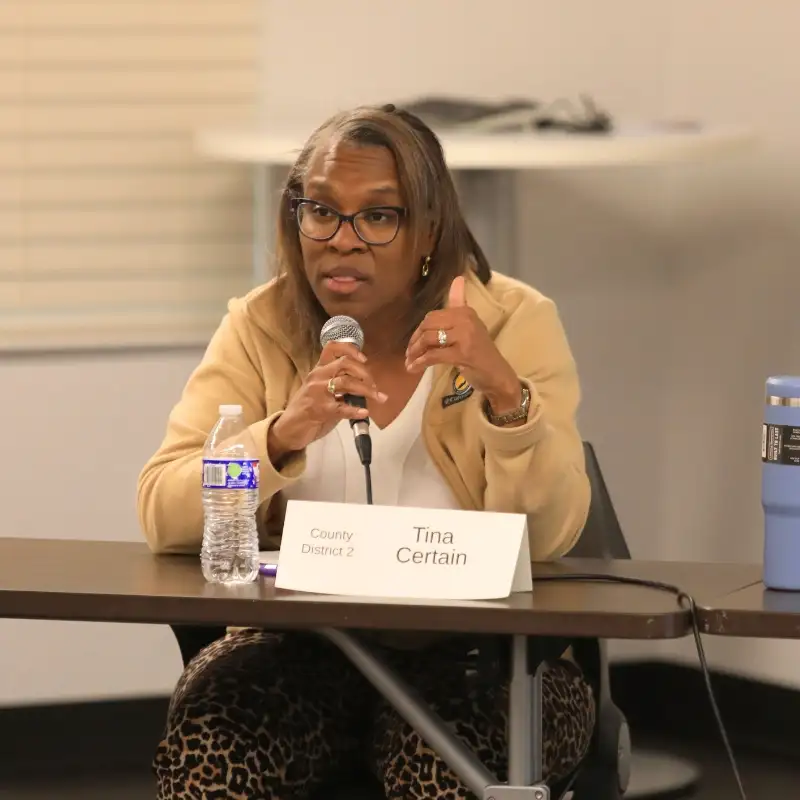
Bonus—Switching from school board to county commission with Tina Certain
Welcome to StreetSmart. It's Monday, November 16, and I'm Lillian Hammam. This week, we've got the second of two interviews that co host Seth Johnson will bring with candidates who won office in August. Nathan Crabbe earned a seat to the Gainesville City Commission while Tina Certain won a spot on the Alachua County Board of County Commissioners. We'll return with our typical episode lineup on November 23.
Lillian:Now here's Seth with the soon to be commissioner, Tina Certain, recorded just before the November third election.
Seth:Welcome back to StreetSmart. I'm Seth. We have got Tina Certain here who won election to the Alachua County Board of County Commissioners in August with a universal primary, and she will be getting into her seat very soon. Right?
Tina Certain:Correct. I'll be sworn in on November 17.
Seth:November 17. However, you're coming from the School Board of Alachua County and so not quite a step from just common citizen to a commissioner, kind of a lateral move we were talking a little bit earlier. How has that time on the school board impacted how you step into this new role?
Tina Certain:Well, I've served eight years as, a school board member. So I've had eight years of experience of evaluating a large, governmental budget budget of a governmental entity. I've had eight years of experience of, considering policies and making public votes, being held accountable for those votes in the public sphere. I've had eight years of experience of working with various leaders, executive leaders of our organization, as well as different board members. Eight years experience of interacting with the community on different levels.
Tina Certain:So I think transitioning over to the county, there are a lot of transferable skills from my professional career before I was elected, as well as things that I've learned and had to be responsible for as part of a board in transitioning over for. One of the things is it is a county level board that's outlined in the constitution. So we've had purview. I'm one of five who sits with the governing authority over the school district for the entire county. So I think the lateral move there, it's a good way of seeing it, having a jurisdiction or oversight for entire county.
Tina Certain:So I think that that is something that citizens saw that was a plus for me in transitioning from school board over to county administration.
Seth:Yeah. Hopefully a little bit less of a steep learning curve with those eight years behind you. Is it a little less daunting as well going into this role versus when you first went to the school board or maybe that one wasn't daunting for you either?
Tina Certain:Remains to be seen, you know, if it's less daunting. I, I don't, I do think it is a shorter learning curve to get up and going. As I said before, I understood, the governmental finance because I had worked on that. Right? So I understood school finance.
Tina Certain:I've become very familiar with that. I think governing and the the lane in which you operate in, and the policy making is a little bit wider on the county. And so I've spent the the past month, I've been, you know, doing some some additional learning on that as well as with the staff. They have a little onboarding process where they've been working with me. So it isn't quite as daunting transitioning over.
Tina Certain:One thing I will say is I'm going in with my eyes a little bit my eyes are open, but it is a little bit more informed. Like when I took my school board seat, the authority and jurisdiction of what I thought the duties of a board member, school board member were, were different. You know, the public thinks that school board members have authority over individual schools and individual decisions. And that is not. The superintendent is the person who has oversight of the daily operations of the district.
Tina Certain:The board really has three primary obligations. We are to set the direction of the district, adopt the strategic plan, come to some consensus on where we want the district to go, hire a superintendent, adopt the budget, and approve policies or recommendations from the superintendent. So it's, that is not what I initially thought. You know, I thought it would have more direct impact on teaching and learning and student outcomes, but we exist, School district exists to improve student outcomes, but the board is not impacting that tangibly. You know, we're between that.
Seth:You have to have kind of an indirect impact versus that direct hands in the classroom, hands on what's going on with teachers through that kind of intermediary.
Tina Certain:Allocating resources, having that as your vision. You know, if three people don't want that to happen and we're really making that a goal of our superintendent and a goal of our organization, it won't happen. Know, nobody's going to... Because you really want to be holding people, and that being the view, not necessarily holding people, accountable, but what you're expecting, the expectation of people is used and the, accountability. That's when things usually happen.
Tina Certain:Have you have an expectation, we're all aligned on what I vision and what we'd like to achieve. And then you work towards that. But when you've got everybody kind of spider veined and going out, makes it hard.
Seth:Yeah, and obviously very similar structure with the county, you know, you're setting policy, you're setting overall goals and strategies and things you want to see done, but perhaps a little more on the ground with some projects, some developments and land use and things that come forward to the county. You're expanding how many employees you get to directly manage, I suppose, with the school board. It's one with the, superintendent with the county. You've got the county manager and the county attorney. So I guess that's slightly different.
Tina Certain:About the same because with the school board, you have a superintendent and the board attorney.
Seth:Oh, you're right. The board attorney as well. It's the exact same structure that Yes. With the school board, you've had a lot of interaction with the county. They work together on, you know, literacy right now, I think of as a close partnership.
Seth:What's been your view of the current county and what they've been accomplishing and just the makeup of the Board?
Tina Certain:My view, the County Board, they've worked well together with the administrator. They seem to have had, everyone has their seems to have an individual initiative that they would like to champion, but they have coalesced very well around working and having alignment around core county functions. And that's been, I think, very good for the county.
Seth:And then with your priorities on the campaign trail, one of them that I noticed kind of at the top of your website was independent leadership. Can you talk a little bit more about that and why you chose to highlight that so prominently for the campaign?
Tina Certain:So I think independent leadership in the sense of being able to, assess an issue, have my own thoughts, and not just be group think. So I think, because that is something that I heard from folks, oh, we have all of our commissioners from... Or all the people are from one party and they're just doing what one person wants them. I am my own person. And I think for myself.
Tina Certain:And I think that that I have shown that over eight years. You know, I'm I'm willing to sometimes to to make a decision that may not be what is everyone is thinking because sometimes what the majority may have... You may hear the loudest voice and this is what what I really found when, with a couple of my school board decisions over the tenure, you know, we've had, since I've served, we had a pandemic, we've had, you know, changes in leadership we've had. Now we've got decline in enrollment and having to adjust our operations based on decline in enrollment, different funding, decrease in funding. And what the majority or what a large...
Tina Certain:I'm not saying the majority because I can't say that. What I will say is a loud contingency was not wanting certain decisions to be made. I had to think through things and evaluate the decision to be made and make a decision. And sometimes it allowed with... It aligned with what the loudest voices in the room were or what the...
Tina Certain:What appeared to be the majority, and sometimes it didn't. And you have to sit with that. Recently, our most recent decision of having to redraw school attendance boundaries and consider consolidations of school, that was a very tough decision. But that is something that I had to do. Back during the pandemic, we had to vote you know, masking and keeping schools open or closing schools and things of that nature.
Tina Certain:That was... I I had to have my independent thought because you have some people who are thinking, you know, you should do it and some people think you... You're not. So I think it's very, that was something that I wanted folks to understand is that that I would be respectful of different opinions, but I would consider, you know, the impact financially, personally, how a decision will work out. And sometimes, you know, we're...
Tina Certain:We've got things in the background and others are... A story sometimes or requirements that everybody may not know. And can't... It's hard to try to educate everyone and everyone may not really understand exactly why a certain decision is made, but folks have trust me to, to not be one to just throw something out there and, or to just take the easiest route.
Seth:You mentioned groupthink. Has that independent leadership been in response to what you've seen as perhaps sharing a lot of the same ideas or a lot of, lack of independent leadership? Or is it just something that you stand for?
Tina Certain:That's just... That's me. You know, was raised, my mother used to say if if if everyone is walking jumping off a bridge, are you gonna go and jump off the ridge as well with them? And I'd I'd like to be... To have my own, mind, and I feel like I'm going to stand and do what I think is right, not what's popular, but I like to try to do.
Tina Certain:I really, really, wrestle with a lot of decisions, lose sleep a lot of times, wrestling with that. So that is something that I really... And I'm not like so unmovable that I can't be moved, but I really do try to make a decision based on the information that's presented. It could be buyers from our our leader, the superintendent, or from staff, what's in statute, what's, you know, happening around us and all of that.
Seth:And you mentioned the loudest voices in the room sometimes can be hard at those meetings to kind of get a consensus on or get an idea of what the full spectrum of thought is. That was something that was also mentioned on your campaign website. You know, every voice deserves to be heard. You said not just the most well connected or the loudest. What's your plan to ensure that happens and what can you implement that you've done on the school board with that?
Tina Certain:I think it is staying in connection with voters and with the citizens of the community and not just going to one group of people, you know, and sometimes the loudest voices in the room, they know how to work the levels of power. And a lot of times those are, and there's nothing wrong with that. Right. I'm not, I'm not criticizing that, but I also don't think that just because you understand and you know the levels of power or you're connected that me as an elected official has always given credence to that. Those in the school district, I I stood and I still stand for those children and families that are at the margins who don't come to meetings, who may not have the access.
Tina Certain:I've had people tell me, you know, I'm working. If I don't go to work, I don't get paid. And so our meetings, even though we meet at six in the PM, the majority of our public meetings are at six we are business meetings rather, are at six because we have workshops, you know, work sessions for the board to be able to talk. Those could be midday. But there are people who work in service sector jobs and those are jobs that don't have a traditional eight to five or nine to six work schedule.
Tina Certain:So... And they've... And people will tell me if I don't go to work, don't get paid. So I think that I can't make a decision just based on a people who understand and know how to organize and know how to, email or get an email campaign going or citizen input campaign going. I shouldn't give credence to just those people.
Tina Certain:I have to consider and make policy because the people who can't attend the meetings, they pay taxes and they're citizens of this community as well. And their views and their needs should be heard on my website as well. Said that government should work for everyone. It should work. It shouldn't just be for one sector.
Seth:And something that impacts everyone is growth. I think that's been kind of a important topic for a lot of voters this year. And you mentioned that that growth has to be smart. It has to keep up with the level of service of infrastructure. How smart has county growth been for the last little bit?
Tina Certain:Well, if you've ever sat in traffic on Newberry Road and Archer Road, we would say we don't think it has been. We don't think, I think that we we let sprawl get out of control and we did not, build roads and alternative routes and connectivity in the past. When the county start to... Started to grow west a lot, we did not, the current leadership at that time did not make some decisions that could have alleviated some of what we're seeing now. We have very few East West quarters and very few quarters that move us North South.
Tina Certain:And because of the growth, so much growth happening, westward it, and we did not... The setback as such where we don't have the capacity now to be able to build additional roads. So I think that there were some considerations that we missed some opportunities, I think in the past, and it's kind of hard now to, to correct that, to rectify that. So, you know, we're trying to add lanes where we can, where there is space to do that, like on Archer Road, for instance, to increase road capacity. But like, you go on Newberry Road, there's from Tower Road back to 122nd, there is not capacity actually to 143rd Street.
Tina Certain:There's not actually to 170 Street. There's not, there isn't room. I don't think to put another lane that and to, to be able to, you know, go on each way to be able to handle additional car traffic. So I think we have to consider a lot of the infrastructure needs along with growth projects at the front end and, so that we can hopefully mitigate some of the problems that we're seeing in certain... You know, out here now.
Seth:You mentioned sprawl and that starting to get out of control, maybe decisions in the past that should have been made, but what decisions can you make moving forward and how long before residents see kind of the benefits of those?
Tina Certain:It's hard for me. I I can't quantify that, Seth. I'm not able to answer that question there. You know, projects go through a developmental review and, you know, there... There's...
Tina Certain:There are projections that are made. You know, some of the the roads like 2024, those are state roads, Newberry Road, this is a state road. And, you know, there are a lot of things that that's outside of the county's jurisdiction, you know, funding for that is outside of our jurisdiction as DOFDOT, you know, controls that the state rule twenty twenty four and twenty six, for instance. So I can't quantify that. That's not something I can give you an answer on, but I do know there are there are processes that are in the play in place.
Tina Certain:And I do like that there's with some of the, the new development that we have that's going out now, just for instance, when a new subdivision goes, is reviewed and approved, for instance, since we're talking about roles and it's been such a topic for people. Now it is part of that where the... When there's maintenance, it has to be done in that there's an assessment that will be made where they have to keep that up. It's not like it's going to all be on the county and folks know that at the beginning of the development. So I think, you know, infrastructure things, that's why we have to be deliberate in our thinking because they are expensive projects and they're in place for a long time.
Tina Certain:And sometimes if we don't make a decision upfront, it may not be possible to correct it and, you know, going forward, unless you use eminent domain or something along that line, you know? So, but I'm not able to just tell you how, give you a time span to say when citizens will be able to, see the impact of that. We're hopeful that good decision making on the front end will yield benefits that will be felt on the back end of a project.
Seth:Yeah. Obviously, infrastructure, it's something that's years just to get through some of the planning phases and then years to get through some the construction and funding and everything else. And you look at even these developments coming in where they have these twenty and thirty and forty year project horizons, where you don't even see the full impact of those developments right away. It's over the course of half of someone's lifetime.
Tina Certain:And even like that's what happens with schools. You may have a very large development and the school concurrency will go for it. Every project that is, submitted goes through the developmental review with the appropriate government agency, of the municipalities or the county. And then it also goes through school concurrency. Well, there's this student generator.
Tina Certain:Well, right now, what we have come to see since I've been on the board is the student generator is actually too high. We're projecting that we will have more students in public schools than what's actually happening. And that is due to a change in school choice laws. So there's an adjustment that has to be made there. And some folks may say, well, we got this neighborhood that's coming.
Tina Certain:Well, we can't build a school or or wait and hold because as you said earlier, some of these these plans are built. They could... Their fate... They're intended to be phased in over ten, twenty, thirty years. But right now, what the...
Tina Certain:We have to make a decision based on school capacity and making sure that we have a space for we have existing students. And sometimes that is not pleasant what people want to hear, but, know, oh, we need a school in this place right here. Yeah. You might, but right now we have to really use, the resources that we have now because it's just such an expense. It's a permanent asset that costs a lot to construct, we really have to be very cautious and judicious in how we proceed forward.
Seth:Talking about the student generator reminds me when developments come in, they have that estimated additional road trips that get put onto the nearby roadways. And it's one of those things where it's an objective engineering stat. And so then there's enough room on the roadways, right? So the development can go forward from that, you know, that's what the county and commissioners are looking at to make their decisions a lot of times. And yet that doesn't quite line up sometimes with the subjective feeling of people driving on those roadways.
Seth:How do those two meet and what can you do there?
Tina Certain:Well, I think sometimes we'll, we're getting that the capacity is the roads are already overcapacity. They're like for, for schools. So I'm not real sure about the roads if it can't stop it. Like for school, concurrency, the way that the policy that the board has is that if there's space in the concurrency district or the one adjacent, right? You make a decision like that.
Tina Certain:They may say there may not be capacity on that road, but there's more capacity on a different, on alternative route. I'm not sure if that is how it's done, but, that's how it's done with schools. You know, some schools may say, well, we're, our school is overcrowded. You need to build another school. Well, that development was approved based on the concurrency rules that are in place that you didn't have any in there.
Tina Certain:Like a lot of school development that's happening in the West is because of capacity, school capacity that exists in the East. But the district, the, the boards in the past have not drawn lines, attendance, lines for students to attend those schools in the East, but the development was approved based on the capacity of schools that existed in the East or in the Alachua region and school develop and lack of school concurrency by state law can't prevent a development from going forward. I'll just throw that out there for what it's worth. That's not our law. That's what's in the statutes.
Seth:Yeah. There's there's strict parameters based on what you can or cannot Right. Improve development or a new zoning or a new land use
Tina Certain:and
Seth:everything else. Mhmm. As you enter the board in the next week, a little over a week, what do you anticipate those first few months to look like, and what projects are you excited to kind of be able to start tackling?
Tina Certain:You know, there... There's the onboarding. There's a learning curve, learning people, their process, you know, watching meetings and all. It's one thing to watch a meeting from TV or in person and another one to sit from the desk. Okay.
Tina Certain:So I do anticipate there to be some learning there. I am waiting to see what happens with amendment three. That is, that will really, I, I anticipate, you know, whatever happens with that, should it pass that will really set the course of what my initial term will look like, because there'll be a period of adjustment and, change in strategy and sorting out a path forward. I would particularly want to work on, you know, housing issues, transportation issues, affordability issues, really expanding economic opportunity, for citizens and our community. That, that is, I think, you know, I've been very fortunate to, to live here.
Tina Certain:My, my husband and I raised our children here and to have the opportunity to have a good job and our children attend good schools. And so I want to work to contribute, to help, to expand that so that everyone has that opportunity. We really need to diversify our employment options in our community. Governmental agencies are our largest employers in our County. Know, UF, either through the health system or the college, the city and the County, Santa Fe, or the school district.
Tina Certain:Those are our largest employers, but we really have got to, I think for the benefit of our community and the diversification of our tax base is to economically bring economic development and economic opportunities to our community.
Seth:Lots of areas where the county touches on that and lots of dependence on things things outside of our control with private companies and people making decisions.
Tina Certain:And hopefully you can, you know, you can go out and court people and, and as a board, I think that is goal of more than just me. And the other members of the board who would also like to see economic development in other parts of all parts of our County, but in parts where the, you know, in the Eastern quadrant of the County is right for that. There's space and there's capacity, but we want to see, opportunities expand for all citizens of our community. Everyone is able to work and earn a good living that impacts businesses and it helps, our tax base, but it also, helps, you know, our youngest students and a reliance on social services and the social safety net for people.
Seth:Well, we'll be looking to see how that happens with this lateral move and all the projects that will be coming before the day before long, where you'll be up there and not just watching the county meetings, but now you'll get to just watch the school board meetings instead.
Tina Certain:Thanks so much for giving me an opportunity to speak with you.